From Uncertainty to Discipline: Ranjini Poddar on Leading What You Can’t Predict
Uncertainty is no longer a surprise event; it is simply how businesses now operate. Economic swings, rapid AI adoption, skills gaps, and new work models mean leaders are making high-stakes workforce decisions without a full picture.
In staffing, how you respond in that environment — and how you help clients respond — defines your relevance. When contingent staffing and workforce solutions sit at the center of business agility, leadership is not about having every answer; it is about building the discipline, partnerships, and fundamentals that hold up even when the path ahead is unclear.
Staffing Industry Review’s recent editorial, “Leading When Nothing is Certain,” explores this same theme and features the perspective of our Co-Founder and CEO, Ranjini Poddar.
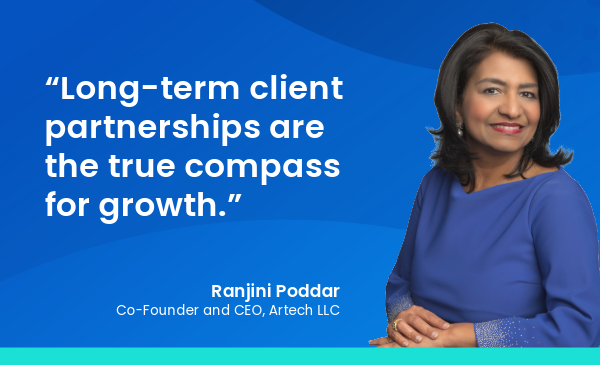
Her quote captures how Artech has chosen to navigate uncertainty — by treating long-term client partnerships and ownership of outcomes as the real compass for growth.
 “Long-term client partnerships are the true compass for growth. That belief shaped how we built Artech. As client needs evolved, we stepped up by taking greater ownership of outcomes, performance, and results. Today, as AI and new work models reshape how organizations operate, the lesson still holds: sustainable leadership comes from disciplined growth, strong fundamentals, and decisions built to last.”
— Ranjini Poddar, Co-Founder and CEO, Artech
This article expands on that perspective: what long-term partnerships look like in practice, how “owning outcomes” changes leadership in staffing, and what 2026 trends mean for leaders navigating uncertainty.
Long-Term Partnerships as a Real-World Compass
At Artech, the starting point is simple: relationships should outlast any single engagement, and the best way to guide a client through uncertainty is to stay deeply invested in their outcomes.
You see this most clearly when the stakes are high. A leading government services contractor was running sensitive engineering and mission-support programs for defense and civilian agencies when three critical software engineering roles sat vacant for over two months. The result was more than $50,000 per month in lost billable revenue and growing concern from a major federal agency customer.
Artech mobilized its cleared-talent network, delivered fully qualified candidates, and filled all three roles within three weeks. Revenue was restored, the program stabilized, and what started as a crisis became the foundation of an ongoing partnership for hard-to-fill, niche technical roles. You can explore more examples in our client case studies.
That is what a long-term partnership looks like in practice: being the partner clients call when the pressure is highest — and delivering.
From Filling Roles to Owning Outcomes
Ranjini’s focus on “taking greater ownership of outcomes, performance, and results” reflects what the industry’s strongest clients now expect from their staffing partners.
Transactional staffing — submitting resumes against requisitions — can close gaps, but it does not build resilience. Strategic staffing aligns to business objectives, maintains governance and SLA performance, and continuously improves delivery. It treats contingent talent as a core workforce lever, not just a cost line to manage.
Recent research underscores why these matter. Deloitte’s 2026 Global Human Capital Trends report notes that competitive advantage now depends on an organization’s ability to build speed and adaptability into its workforce decisions. Achieving that adaptability requires staffing partners that own delivery quality and program outcomes, not just order fulfillment.
2026 Staffing Trends: AI, New Work Models, and What Leaders Need
The forces reshaping staffing are accelerating, not slowing down. SIA projects the U.S. staffing market will grow roughly 2% in 2026 to reach around $183.3 billion, with demand recovering unevenly and concentrating in specialized, high-skill roles. At the same time, enterprises are rethinking how work gets done end-to-end.
BCG’s research shows that about 70% of AI transformation value comes from rethinking the people side, not just the technology itself, and that “future-built” organizations plan to upskill more than half of their employees in AI-related skills. Accenture’s 2026 Pulse of Change data reinforces this: organizations that win combine confidence in technology investments with a real commitment to workforce readiness.
For staffing leaders, that creates a clear mandate: stop acting like a vendor and start acting like an advisor. Clients navigating AI adoption, distributed teams, and expanding contingent workforces need partners who bring structure, governance, and insight — not just speed. The future belongs to firms that can connect AI, human expertise, and resilient workforce models into decisions that last.
Disciplined Growth and Decisions Built to Last
When Ranjini talks about “disciplined growth and strong fundamentals,” it shows up in concrete operational commitments rather than slogans.
- Governance and data-driven oversight across contingent programs, giving clients visibility, compliance, and continuous performance improvement.
- Risk and compliance frameworks designed for the regulatory and contractual complexity of government, defense, and other regulated industries.
- Global delivery with local expertise, combining scale with the sector-specific context clients require.
- A people-first culture that treats both client outcomes and worker experience as non-negotiable.
These are the reasons clients come back in a crisis — and why partnerships tend to grow stronger under pressure.
Key Staffing Leadership Insights for 2026
- Long-term partnerships outperform transactional staffing models in uncertain environments.
- Workforce agility depends on clear governance, data-driven visibility, and delivery accountability.
- AI transformation delivers value only when it is matched with serious investment in workforce readiness.
- Strategic staffing partners are essential to long-term business resilience, not just short-term hiring.
For leaders planning their 2026 staffing strategy, the message is straightforward: choose partners who own outcomes with you, build fundamentals that can handle change, and treat uncertainty as the normal condition you are designing for — not a temporary disruption.
About Ranjini Poddar, CEO of Artech
Ranjini Poddar is the Co-Founder and CEO of Artech, one of the largest women-owned IT staffing firms serving enterprise clients across the United States and globally. She leads Artech’s workforce solutions strategy and is a frequent contributor to industry discussions on staffing trends, workforce strategy, and the future of work.
Frequently Asked Questions
How can staffing leaders prepare for staffing trends in 2026?
Focus on building long-term partnerships, investing in data-driven governance, and treating contingent talent as a strategic asset rather than a short-term cost.
What does “owning outcomes” mean in staffing partnerships?
It means aligning to business results, not just requisitions — taking responsibility for delivery quality, SLAs, compliance, and continuous improvement across the workforce program.
Why is AI relevant to staffing industry leadership?
AI is reshaping how organizations find, match, and manage talent, but the biggest impact comes when technology is paired with strong fundamentals, governance, and a people-first approach.
Read the full Staffing Industry Analysts editorial: Leading When Nothing is Certain.
Discover how Artech’s contingent workforce and staffing solutions can support your 2026 workforce strategy. Explore our contingent staffing and workforce solutions or contact our team to discuss your business goals.
You also might be interested in
 How to Spot and Avoid Recruiting Scams A Consultants Guide scaled
 Introduction In today’s hyper-connected world, job searching has moved almost[...]
 Pharma Careers 2025
 Why Location Still Matters for Your Career The life sciences[...]
 Blog image Cybersecurity
 Organizations often urge employees to create strong passwords, report[...]